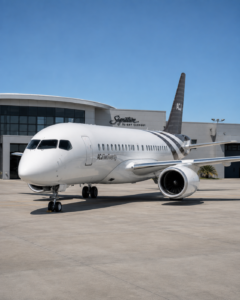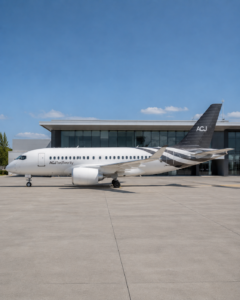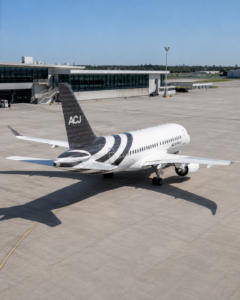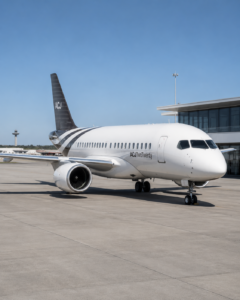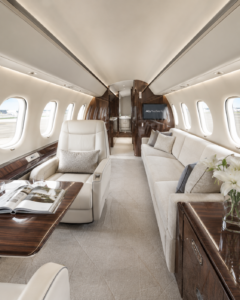

Airbus ACJ TwoTwenty:

Why the Aircraft Is Only Half of the Acquisition Decision
Buying an Airbus ACJ TwoTwenty is not simply the purchase of a larger private jet.
It is the acquisition of an aircraft that sits between two traditionally separate worlds: the ultra-long-range business jet and the Airbus corporate jet.
With 5,650 nautical miles of maximum range, more than 12 hours of nonstop capability and approximately 73 square metres of cabin floor space, the ACJ TwoTwenty offers a very different proposition from a conventional large-cabin business jet.
But its size, configuration possibilities and operating concept also make the acquisition process more complex.
For a private owner, family office or corporation considering an ACJ TwoTwenty purchase, the important question is therefore not simply:
“Is this the aircraft I want?”
It is:
“Is this the right aircraft for the way I intend to travel, own and eventually sell it?”
That is where independent aircraft acquisition advisory becomes particularly valuable.
What is the Airbus ACJ TwoTwenty?
The ACJ TwoTwenty is Airbus Corporate Jets’ business aviation derivative of the A220 platform.
Rather than simply converting a conventional airliner into a VIP aircraft, Airbus developed the TwoTwenty specifically around corporate aviation requirements, combining the A220 platform with additional fuel capacity, increased range and a dedicated VIP cabin concept.
The result occupies a category Airbus describes as an “Xtra Large Bizjet.”
Its dimensions help explain why.
The ACJ TwoTwenty offers approximately:
- 5,650 NM maximum range
- More than 12 hours of nonstop flight
- 73 m² / 786 ft² of cabin floor area
- 5,120 ft³ of cabin volume
- 23.8 metres of cabin length
- 3.3 metres of cabin width
- Up to six living zones
- PW1500G engines
- 41,000 ft maximum cruise altitude
For a private aircraft buyer, however, these specifications should be the beginning of the analysis rather than the conclusion.
Why the ACJ TwoTwenty is different from buying a traditional business jet
Most buyers entering the ultra-long-range market are familiar with aircraft such as the Gulfstream G700 or G800, Bombardier Global 7500 or Global 8000 and Dassault Falcon family.
The TwoTwenty approaches private aviation differently.
Its principal advantage is not maximum speed or extreme range.
It is space.
The cabin is dramatically larger than that of a traditional purpose-built business jet while the aircraft remains capable of operating from many airports commonly used by business aviation.
This creates a different value proposition.
An owner can create genuine separate environments for:
- business meetings;
- dining;
- entertainment;
- family travel;
- guest accommodation;
- private office use;
- sleeping;
- crew rest;
- a private bedroom;
- an en-suite bathroom.
For someone spending hundreds of hours per year travelling internationally, that additional space can change the aircraft from a means of transportation into something closer to a private residence and office in the air.
But additional space only creates value if the owner will actually use it.
The first step in buying an ACJ TwoTwenty: analyse the mission
Before selecting the aircraft, an acquisition advisor should understand the owner’s travel.
Not the theoretical travel.
The actual travel.
A proper mission analysis should examine questions such as:
Where will the aircraft be based?
An owner operating from Nice, Geneva, Zurich, Milan, Paris or London has a different geographical starting point from an owner based in Dubai, Riyadh, Singapore or New York.
Which destinations are flown most frequently?
The aircraft required for regular Europe–Middle East and Europe–North America operations may be very different from one regularly operating Europe–Asia-Pacific missions.
How many passengers normally travel?
A couple travelling with two passengers has very different cabin requirements from a principal routinely travelling with family, executives, personal staff and security.
How important are overnight missions?
A genuine bedroom, bathroom and separated crew areas become much more valuable when long overnight sectors represent a significant proportion of annual flying.
Which airports are essential?
Range should always be assessed alongside runway length, airport restrictions, parking, handling facilities and hangar availability.
The objective is not to prove that the ACJ TwoTwenty can perform the mission.
It is to determine whether it performs that mission better enough to justify the ownership decision.
5,650 NM: how much range does an owner actually need?
The ACJ TwoTwenty offers intercontinental range rather than the extreme 7,500- to 8,000-NM capability offered by today’s highest-range business jets.
That distinction matters.
A buyer should never assume that more range automatically means a better aircraft.
For an owner whose flights are concentrated around:
Europe – North America
Europe – Middle East
Europe – Africa
Middle East – Europe
Asia-Pacific regional and intercontinental missions
5,650 NM may cover a substantial percentage of annual requirements.
Airbus identifies city pairs such as London–Los Angeles, Dubai–Tokyo and Beijing–Sydney as representative of the aircraft’s capabilities under appropriate conditions.
For owners regularly requiring longer missions beyond the aircraft’s practical range envelope, an aircraft such as a Gulfstream G800, Global 8000 or another ultra-long-range platform may be more appropriate.
This is precisely why acquisition advice should come before aircraft selection.
Sometimes the right recommendation is the aircraft the client initially wanted.
Sometimes it is not.
ACJ TwoTwenty acquisition: cabin specification is part of the investment
One of the biggest differences between acquiring an aircraft such as the TwoTwenty and buying a conventional pre-owned business jet is the importance of the cabin.
The ACJ TwoTwenty provides six large living zones, each approximately the size of a small room.
The buyer can therefore make decisions that go far beyond selecting leather colours or veneer.
The cabin can include combinations of:
- reception and entrance areas;
- business lounges;
- conference and dining spaces;
- entertainment lounges;
- private office areas;
- bedrooms;
- full-size beds;
- en-suite bathroom facilities;
- showers;
- dedicated crew areas;
- large-screen entertainment systems.
This creates extraordinary flexibility.
It also creates opportunity for expensive mistakes.
A highly personalised cabin may be perfect for one owner but significantly reduce the aircraft’s attractiveness to the next buyer.
A good acquisition strategy therefore considers resale before the aircraft has even been purchased.
Personalisation versus resale value
Private aircraft owners understandably want an aircraft that reflects their preferences.
But aircraft are also depreciating capital assets.
The challenge is finding the correct balance.
An unusually specific interior colour palette, highly personalised layout or unconventional cabin arrangement may be enjoyable during ownership but narrow the pool of future buyers.
Conversely, designing an aircraft only around future resale can prevent the owner from benefiting from the very reason for purchasing such an aircraft in the first place.
The correct approach is not to avoid personalisation.
It is to identify which elements are easily reversible and which permanently influence the aircraft’s marketability.
An acquisition advisor can therefore contribute before cabin decisions are finalised by analysing:
- current market preferences;
- typical passenger requirements;
- cabin layouts;
- future refurbishment complexity;
- technology obsolescence;
- connectivity;
- material durability;
- likely resale audience.
The cabin should work for today’s owner without unnecessarily excluding tomorrow’s buyer.
New ACJ TwoTwenty or pre-owned aircraft?
As the TwoTwenty fleet grows, buyers will increasingly face another question:
Should I order an aircraft, acquire an existing delivery position or purchase a pre-owned ACJ TwoTwenty?
There is no universal answer.
A new aircraft offers greater control over specification and cabin choices.
A pre-owned aircraft may provide:
- faster availability;
- an existing completed cabin;
- known equipment;
- potentially different economics;
- reduced exposure to the completion and delivery process.
But buying a pre-owned corporate jet requires careful aircraft-specific due diligence.
Airbus itself recommends that buyers of pre-owned ACJ aircraft perform a Pre-Purchase Inspection through an appropriate service provider.
That inspection is only one part of the acquisition process.
Buying a pre-owned ACJ TwoTwenty: the aircraft must be evaluated individually
Two ACJ TwoTwenty aircraft of the same age can represent very different acquisitions.
A professional evaluation should consider areas including:
- total aircraft hours and cycles;
- utilisation profile;
- maintenance history;
- technical records;
- engine condition;
- engine coverage and programmes;
- avionics configuration;
- modifications;
- cabin condition;
- connectivity systems;
- damage and repair history;
- corrosion exposure;
- operating geography;
- current maintenance status;
- upcoming inspections;
- warranty status;
- compliance requirements;
- cabin equipment;
- ownership and title history.
A low asking price does not automatically mean good value.
An aircraft approaching expensive maintenance, cabin refurbishment or systems upgrades can quickly become more expensive than another example initially offered at a premium.
The Pre-Purchase Inspection is not a formality
A Pre-Purchase Inspection, or PPI, is one of the most important protections available to an aircraft buyer.
Its purpose is not merely to prove that the aircraft can fly.
It should help identify the technical and financial exposure the buyer may inherit at closing.
Depending on the aircraft and transaction, the process can reveal:
- discrepancies;
- maintenance items approaching due dates;
- records deficiencies;
- cosmetic deterioration;
- structural findings;
- engine or system issues;
- deferred defects;
- required modifications.
The commercial importance is equally significant.
Findings discovered during inspection may affect:
- purchase price;
- seller obligations;
- rectification requirements;
- closing conditions;
- delivery timing;
- the decision to proceed at all.
The earlier these risks are understood, the stronger the buyer’s position.
Negotiating the aircraft is more than negotiating the price
Aircraft buyers naturally focus on purchase price.
But a successful aircraft negotiation involves significantly more.
The value of a transaction can depend on terms covering:
- refundable versus non-refundable deposits;
- inspection scope;
- delivery condition;
- maintenance status;
- discrepancy rectification;
- records;
- equipment included in the sale;
- closing location;
- taxes;
- title;
- registration;
- acceptance procedures;
- delivery timing.
An aircraft that is purchased slightly below market value but delivered with substantial unresolved technical exposure may ultimately be a poor acquisition.
Equally, paying a reasonable premium for an exceptional aircraft with favourable maintenance status and specification can be financially rational.
Purchase price and acquisition value are not the same thing.
Why independent representation matters when buying an aircraft
In many aircraft transactions, several parties are involved.
There may be:
- the manufacturer;
- seller;
- seller’s broker;
- aircraft operator;
- maintenance organisation;
- completion centre;
- lawyers;
- financiers;
- insurance advisers;
- registration specialists.
Each performs an important role.
But not every participant represents the buyer’s interests.
An independent aircraft acquisition advisor should sit on the buyer’s side of the table.
The objective is not simply to complete the transaction.
It is to determine whether the transaction should be completed at all — and on what terms.
That distinction becomes particularly important when acquiring a highly valuable and sophisticated asset such as an Airbus Corporate Jet.
Buying an ACJ TwoTwenty from Europe
For buyers based in Monaco, France, Switzerland, Italy, Luxembourg, the United Kingdom or elsewhere in Europe, aircraft acquisition can also involve decisions extending beyond aircraft selection.
These may include:
- ownership structure;
- aircraft registration;
- operator selection;
- management arrangements;
- VAT and tax considerations with qualified tax advisers;
- insurance;
- crew recruitment;
- maintenance support;
- hangar and parking;
- operational approvals;
- import and export considerations.
These subjects require specialist legal, fiscal and regulatory advice where applicable.
But they should be coordinated as part of the overall acquisition strategy.
Aircraft ownership works best when these decisions are considered before delivery, not after the aircraft has already been purchased.
Who will operate the aircraft?
Buying the aircraft is only the beginning.
The owner must decide how it will be operated.
That may involve establishing or using an existing flight department, selecting an aircraft management company or appointing a professional operator.
The analysis should consider:
- anticipated annual utilisation;
- crew numbers;
- pilot qualifications;
- cabin crew requirements;
- recurrent training;
- maintenance management;
- scheduling;
- dispatch;
- insurance;
- fuel procurement;
- handling;
- operational control.
For a large-cabin aircraft, management quality can have a material effect on both the owner’s experience and the long-term condition of the asset.
Good aircraft management should protect availability today and residual value tomorrow.
The ACJ TwoTwenty’s A220 heritage can be an ownership advantage
The TwoTwenty is based on Airbus’ A220 platform.
That brings a different ecosystem from that of many conventional business jets.
The wider A220 programme provides a global operational and technical background, while ACJ customers receive dedicated Airbus Corporate Jets support.
Airbus also maintains an ACJ Service Centre Network covering maintenance, cabin refurbishment, systems upgrades and aircraft transfer support.
For a buyer, support infrastructure matters.
An extraordinary aircraft that is difficult to maintain in the regions where it operates can rapidly become frustrating.
Availability, spare parts, technical expertise and maintenance planning should therefore form part of the aircraft-selection process.
Cabin space versus airport footprint
One reason the ACJ TwoTwenty is particularly interesting is that cabin size does not tell the entire operational story.
Despite offering significantly more interior space than a traditional large-cabin business jet, Airbus has specifically positioned the aircraft to remain compatible with airports used by business aviation.
The company has highlighted operations from airports such as London City and Singapore Seletar, alongside other demanding destinations.
This creates an unusual proposition:
a cabin approaching the experience of a much larger corporate aircraft without necessarily accepting all the operational limitations traditionally associated with larger converted airliners.
For certain owners, that combination may be more important than headline maximum range.
ACJ TwoTwenty vs a traditional ultra-long-range business jet
A buyer comparing an ACJ TwoTwenty with a Gulfstream, Bombardier Global or Dassault Falcon should avoid trying to identify a universal winner.
The aircraft are built around different priorities.
A traditional ultra-long-range jet may offer:
- greater maximum range;
- higher cruise speeds;
- smaller external dimensions;
- a larger existing pre-owned fleet;
- a more conventional business aviation operating model.
The ACJ TwoTwenty may offer:
- dramatically greater cabin floor area;
- six living zones;
- a true bedroom and residential-style spaces;
- very substantial baggage capacity;
- intercontinental rather than extreme ultra-long-range performance;
- an unusual balance between cabin size and airport accessibility.
The choice depends on what the owner values.
For some buyers, flying nonstop 1,500 or 2,000 additional nautical miles will be critical.
For others, spending ten hours in a cabin with dramatically more usable space will matter much more.
The purchase decision should quantify that difference.
How an aircraft acquisition advisor should approach an ACJ TwoTwenty purchase
A structured acquisition can be divided into several stages.
1. Mission analysis
Understand where, how often, with whom and under what conditions the owner expects to fly.
2. Aircraft selection
Determine whether the ACJ TwoTwenty is genuinely the optimal solution compared with alternatives.
3. Market analysis
Assess available aircraft, delivery possibilities, current market conditions and comparable opportunities.
4. Commercial strategy
Establish target value, transaction structure and negotiation parameters.
5. Aircraft and records evaluation
Analyse the individual aircraft, specification, maintenance status and documentation.
6. Pre-Purchase Inspection
Coordinate an appropriate technical inspection and assess findings.
7. Negotiation and closing support
Protect the buyer commercially while legal specialists address contractual and ownership documentation.
8. Delivery and entry into service
Coordinate aircraft acceptance and operational preparation.
9. Management after acquisition
Ensure the asset continues to be operated, maintained and managed according to the owner’s objectives.
The objective should be continuity.
The decisions made before acquisition influence the cost and quality of ownership for years afterwards.
The best aircraft acquisition starts with the exit strategy
This may seem unusual.
Why discuss selling an aircraft before buying it?
Because aviation assets are rarely owned forever.
An owner may change:
- travel patterns;
- family requirements;
- business interests;
- home base;
- fleet strategy;
- aircraft preferences.
Technology also evolves.
New aircraft enter the market.
Range increases.
Connectivity improves.
Cabin expectations change.
A successful acquisition should therefore consider what could make the aircraft desirable when the owner eventually decides to sell it.
That includes:
- specification;
- cabin layout;
- maintenance programmes;
- records quality;
- ownership history;
- modifications;
- condition;
- utilisation.
The objective is not to predict the future perfectly.
It is to avoid decisions today that unnecessarily restrict future options.
Considering the acquisition of an Airbus ACJ TwoTwenty?
An aircraft of this scale should not be purchased from specifications alone.
At Superba Consulting, we advise private owners, companies and aircraft buyers throughout the acquisition process, combining operational aviation experience with commercial and technical aircraft knowledge.
From defining the mission and identifying the right aircraft to market analysis, technical evaluation, negotiation, acquisition and management after delivery, the objective is to represent the owner’s interests throughout the entire process.
Because buying the aircraft is one transaction.
Living with the decision is the investment.
If you are considering acquiring an Airbus ACJ TwoTwenty, another Airbus Corporate Jet or a large-cabin business aircraft, contact Superba Consulting for an independent assessment of the aircraft, the market and your mission requirements.