

Dassault Falcon 10X vs Falcon 6X: Which Falcon Is Right for Your Mission?
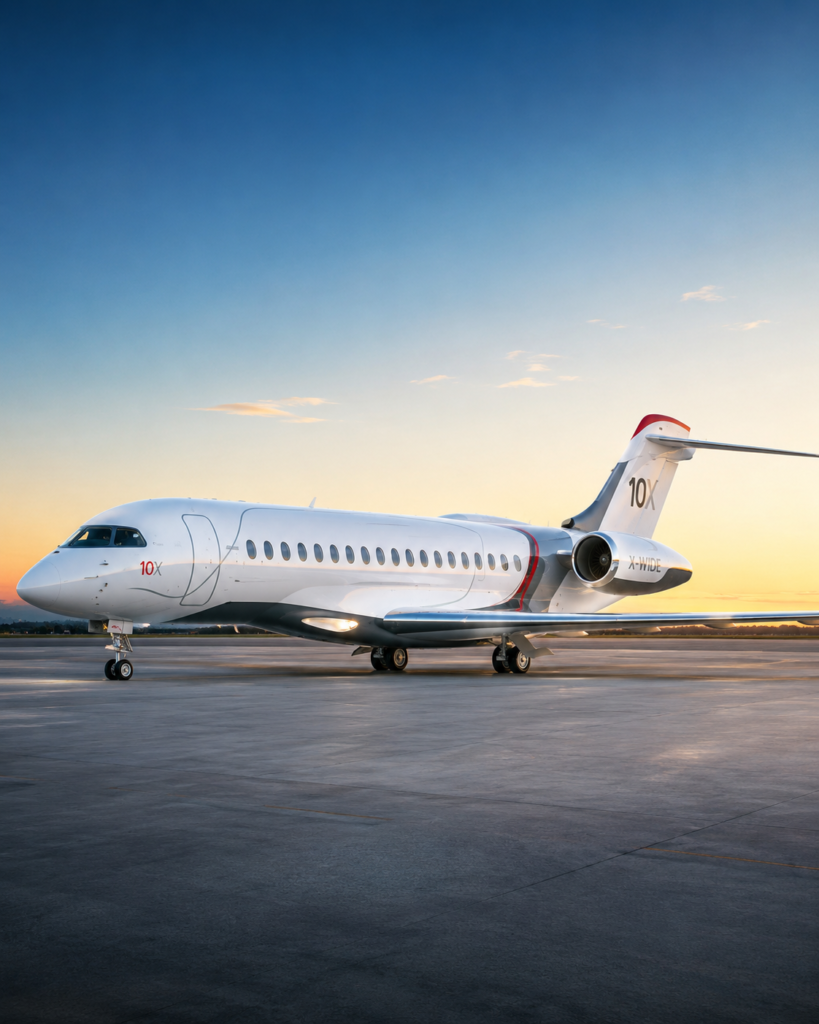
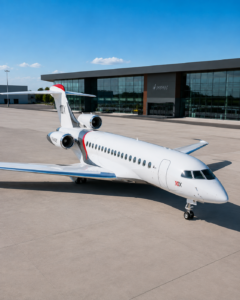
The Dassault Falcon 10X is designed to become the largest, longest-range and most technologically advanced aircraft in the Falcon family. The Falcon 6X, meanwhile, is already flying.
That distinction alone makes comparing the two aircraft more interesting than simply placing their specifications side by side. One offers 7,500 nautical miles of planned maximum range, Mach 0.925 performance and one of the largest cabins ever created for a purpose-built business jet; the other offers 5,500 nautical miles of range, an exceptionally wide cabin and the short-field flexibility for which Falcon aircraft have traditionally been known, in a platform that entered service in 2023.
So which is the better aircraft?
For a private aircraft buyer, that is the wrong question – The better question is:
How much range, cabin and aircraft do you actually need?
For an owner operating from Monaco, Nice, Geneva, Zurich, Milan, Paris or London, or moving frequently between Europe, North America, the Middle East and Asia, the answer can lead to two very different acquisition strategies.
Falcon 10X vs Falcon 6X: the short answer
The Falcon 10X is Dassault’s new ultra-long-range flagship.
It is designed for owners who need:
- up to 7,500 NM of range;
- a top speed of Mach 0.925;
- an exceptionally large and highly configurable cabin;
- up to 19 passengers;
- three or four substantial living zones;
- extremely long intercontinental missions;
- the latest generation of Dassault flight deck and flight-control technology.
The Falcon 6X operates in a different part of the market.
It offers:
- up to 5,500 NM of range;
- a maximum operating speed of Mach 0.90;
- up to 16 passengers;
- three principal lounge areas;
- a very wide large-cabin interior;
- exceptional short-field and steep-approach capability;
- enough range for a significant proportion of international business aviation missions.
The difference between them is therefore not simply 2,000 nautical miles.
It is a difference in mission philosophy.
Falcon 10X vs Falcon 6X
The figures show an obvious difference in performance.
But the numbers do not explain why an owner might rationally choose one over the other.
First, an important distinction: the Falcon 10X is not yet an aircraft in service
Any serious Falcon 10X vs Falcon 6X comparison in 2026 needs to begin here.
The Falcon 10X completed its maiden flight from Bordeaux-Mérignac on June 19, 2026.
That flight marked the beginning of Dassault’s certification flight-test campaign.
The first test aircraft is expected to be joined by additional aircraft, including one equipped with a complete cabin interior for systems, functional and reliability testing.
The Falcon 6X is in a completely different phase of its lifecycle.
It received FAA and EASA certification in August 2023 and entered service on November 30, 2023.
For a buyer looking for an aircraft that can be delivered and operated now, that distinction matters.
For a buyer planning the next generation of a corporate or private flight department, the 10X may instead represent a longer-term fleet decision.
Falcon 10X: 7,500 nautical miles changes the geography
The Falcon 10X is designed to fly approximately 7,500 NM at Mach 0.85 with eight passengers under Dassault’s published reference conditions.
That puts it firmly into the ultra-long-range category.
Dassault identifies potential nonstop city pairs including:
New York – Shanghai
Los Angeles – Sydney
Paris – Santiago
São Paulo – Dubai
Those missions tell us more about the aircraft than the range figure alone.
A 7,500-NM aircraft is not intended simply to make a transatlantic flight easier.
Aircraft such as the 10X are designed around the possibility of crossing continents and oceans while reducing or eliminating technical stops.
For a principal whose business routinely connects Europe, Asia, the Middle East and North America, that can substantially change how a private aircraft is used.
Falcon 6X: 5,500 NM may already be more than enough
The Falcon 6X has a published maximum range of 5,500 NM at Mach 0.80 and approximately 5,100 NM at Mach 0.85.
It can perform missions such as:
Los Angeles – Geneva
Paris – Beijing
Los Angeles – London
under suitable conditions.
That is already significant intercontinental capability.
And this creates the central acquisition question:
How often does an owner really need the additional 2,000 NM offered by the Falcon 10X?
If the answer is every week, the 10X may fundamentally improve the owner’s travel.
If the answer is once or twice per year, the financial analysis changes completely.
Owning an aircraft capable of the most extreme mission in your calendar is not always the same thing as owning the aircraft best suited to your typical mission.
The real difference is not range. It is mission margin.
Aircraft range is often misunderstood.
A 7,500-NM maximum range does not mean that every 7,500-NM journey will always be operated nonstop under every condition.
Actual aircraft performance is influenced by:
- winds;
- temperature;
- passenger load;
- baggage;
- reserves;
- airport elevation;
- ATC routing;
- alternates;
- aircraft configuration;
- cruise strategy.
That is why additional range should also be viewed as operational margin.
An owner may never intend to fly exactly 7,500 NM.
But an aircraft with a larger performance envelope gives dispatchers and crews more flexibility when conditions are unfavourable.
For globally mobile principals, that additional margin can be extremely valuable.
Falcon 10X vs Falcon 6X cabin: this may be the biggest difference of all
The range attracts the headlines.
The cabin may be the more dramatic difference.
The Falcon 6X is already a remarkably wide business jet.
Its cabin measures approximately:
6 ft 6 in high
8 ft 6 in wide
40 ft 4 in long
That translates into approximately 1,843 cubic feet of cabin volume.
The Falcon 10X moves substantially beyond it.
Its cabin is approximately:
6 ft 8 in high
9 ft 1 in wide
53 ft 10 in long
with approximately 2,780 cubic feet of cabin volume.
That is not a marginal increase.
The Falcon 10X cabin offers roughly 50 percent more volume than the 6X.
For passengers spending 12, 13 or 14 hours in the aircraft, that can fundamentally change the experience.
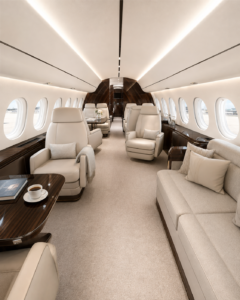
The Falcon 10X is designed less like a jet cabin and more like a private interior
The 10X can be divided into three or four major living zones, each with individual temperature control.
The size of the cabin allows owners considerably more freedom in how those spaces are used.
Depending on configuration, that could mean:
- a large dining and conference area;
- a dedicated private office;
- entertainment space;
- separate passenger lounges;
- crew-rest facilities;
- a private bedroom;
- a large rear suite;
- potentially a permanent bed rather than one created by converting seats.
That final point matters more than it might initially appear.
On a four-hour flight, converting a seat into a bed is irrelevant.
On an ultra-long-range overnight mission, the ability to create a genuine private sleeping environment becomes an operational part of the cabin.
The aircraft becomes a place in which the owner lives and works, rather than simply travels.
But the Falcon 6X cabin should not be underestimated
Choosing the 6X does not mean accepting a conventional small cabin.
Far from it.
The Falcon 6X was itself created around a particularly wide cross-section and can accommodate up to 16 passengers depending on configuration.
Its interior can include:
- three separate lounge areas;
- crew-rest accommodation;
- an enlarged galley and entrance area;
- a private rear stateroom;
- working and dining areas.
It also uses approximately 30 large windows, creating a cabin with substantial natural light.
For missions of six, eight or ten hours, many owners may conclude that the 6X already offers more than enough space.
Which raises another useful question:
Is greater cabin volume valuable to you, or simply available to you?
Those are not the same thing.
A 10X is not simply a larger 6X
This is important.
The Falcon 10X is not the result of taking the Falcon 6X and stretching the fuselage.
It represents a new aircraft architecture.
Among the major differences are:
- a new composite wing;
- Rolls-Royce Pearl 10X engines;
- new high-speed aerodynamics;
- Dassault’s next-generation Digital Flight Control System;
- the new NeXus flight deck;
- Smart Throttle;
- new automatic protection and recovery functions.
Dassault has used technology developed through both its civil and military aircraft programmes.
That engineering connection between Falcon business jets and Dassault’s combat-aircraft expertise is particularly visible in the 10X’s flight-control philosophy.
NeXus vs EASy IV: the cockpit difference
The Falcon 6X uses Dassault’s EASy IV flight deck, based on Honeywell’s Primus Epic architecture.
It is an evolution of a cockpit philosophy already familiar across the modern Falcon family.
The Falcon 10X introduces NeXus, Dassault’s next-generation flight deck.
This includes extensive touchscreen integration and combines with a new-generation Digital Flight Control System.
Among the technologies highlighted by Dassault for the 10X are:
- Smart Throttle controlling both engines;
- advanced head-up display technology;
- FalconEye enhanced vision;
- automatic recovery from unusual attitudes;
- automatic terrain-avoidance functions;
- automatic windshear recovery assistance.
Some of these technologies have clear links to Dassault’s decades of experience designing military aircraft.
For owners, these features may appear to concern pilots rather than passengers.
But cockpit technology influences safety, crew workload, training, aircraft capability and ultimately asset desirability.
Two engines, but two completely different powerplants
The Falcon 6X is powered by two Pratt & Whitney Canada PW812D engines, each delivering approximately 13,500 lb of thrust.
The Falcon 10X moves to the Rolls-Royce Pearl 10X, producing more than 18,000 lb of thrust per engine.
That reflects the difference in scale between the aircraft.
Maximum takeoff weight increases from approximately 77,500 lb on the Falcon 6X to 115,000 lb on the Falcon 10X.
So although both aircraft are twin-engine Falcons, they belong to substantially different weight and performance categories.
For an owner, this also means that comparisons should eventually include engine support programmes, maintenance exposure, utilisation and long-term operating economics — not simply fuel consumption.
Airport flexibility: where the Falcon 6X becomes particularly interesting
Long range is only useful if the aircraft can use the airports the owner needs.
This has historically been an important part of Falcon design.
The Falcon 6X can operate steep approaches and has been designed to access demanding airports including London City, Lugano and other fields where runway length or approach geometry can restrict larger business jets.
Dassault publishes a balanced field length of approximately 5,115 ft at maximum takeoff weight under reference conditions and an approach speed around 110 KIAS under its stated configuration.
This is one of the reasons a 6X should not automatically be viewed as simply “less aircraft” than a 10X.
For some owners, arriving closer to the final destination can save more time than carrying another 2,000 NM of theoretical range.
Imagine an owner based between Monaco, Geneva and Milan
This is where the difference becomes easier to understand.
Consider an owner whose aircraft operates primarily from Nice Côte d’Azur, Geneva or Milan.
Annual travel consists mostly of:
- London;
- Paris;
- Madrid;
- Dubai;
- Riyadh;
- New York;
- Miami;
- North Africa;
- occasional destinations farther east.
A Falcon 6X can address a very substantial proportion of those missions.
Now consider another owner whose regular programme includes:
- Singapore;
- Hong Kong;
- Shanghai;
- Los Angeles;
- Santiago;
- São Paulo;
- repeated Europe–Asia missions.
The additional range of the Falcon 10X begins to change from a specification into a practical operating advantage.
Same manufacturer.
Different travel pattern.
Different answer.
Monaco and the French Riviera: airport access matters as much as range
For a private owner based in Monaco, the practical aviation gateway is typically Nice Côte d’Azur Airport, supplemented by other business aviation airports around the French Riviera depending on aircraft and mission.
That creates an interesting dynamic.
The owner may live in a geographically compact European environment but operate globally.
A typical week could involve Nice–London followed by Nice–Dubai.
Another could involve a long-range mission to the United States or Asia.
In that environment, choosing between a Falcon 6X and 10X should not be driven by prestige or model hierarchy.
It should be driven by how frequently the aircraft will genuinely exploit ultra-long-range capability.
Geneva, Zurich and Milan tell a similar story
European aircraft owners often operate from locations where major international destinations are already well positioned geographically.
From Geneva, Zurich, Milan, Paris or London, a 5,500-NM aircraft can reach a remarkable number of business centres nonstop under suitable conditions.
That can make the Falcon 6X highly effective.
The Falcon 10X becomes more compelling when the owner’s travel extends regularly toward the edges of that envelope — particularly deeper into Asia, the western United States, South America or other ultra-long-range destinations.
The acquisition therefore begins with plotting actual city pairs.
Not browsing aircraft brochures.
Falcon 10X vs Falcon 6X: speed matters differently on long missions
The Falcon 6X has a maximum operating speed of Mach 0.90.
The Falcon 10X increases that to Mach 0.925.
On a short European sector, the difference may be practically insignificant.
On very long intercontinental flights, speed becomes more relevant.
But even here, maximum Mach should not be mistaken for normal cruise speed throughout every mission.
Flight crews optimise speed according to:
- range required;
- winds;
- fuel;
- ATC conditions;
- arrival requirements;
- operational priorities.
What the additional performance gives the 10X is choice.
And in ultra-long-range business aviation, flexibility frequently matters more than the headline number.
When the Falcon 6X may actually be the smarter aircraft
A buyer should seriously consider the 6X when:
Most flights remain below the 6X’s practical range envelope
If the majority of annual flying consists of European, Middle Eastern and transatlantic missions, the additional capability of a 10X may be rarely exploited.
Short-field flexibility matters
If access to airports such as London City, Lugano or other constrained destinations is operationally important, mission analysis deserves particular attention.
The cabin is already sufficient
The Falcon 6X cabin is exceptionally wide and capable of three substantial living areas. Not every owner requires another 13 feet of cabin length.
Aircraft availability matters now
The 6X is certified and in service. The 10X remains in development and certification as of 2026.
Capital efficiency matters
The correct financial comparison is not simply purchase price. It is the total capital and operating cost required to satisfy the owner’s actual mission profile.
When the Falcon 10X changes the equation
The 10X becomes significantly more compelling when:
Ultra-long-range missions are routine rather than exceptional
An owner regularly connecting distant continents can obtain genuine value from the additional 2,000 NM.
Cabin separation is important
Travelling with family, executives, guests, staff or security personnel can create a need for genuinely independent living spaces.
The aircraft is used as a flying office and residence
For principals spending hundreds of hours per year airborne, additional cabin volume has greater value.
Overnight missions are common
A genuinely private sleeping environment becomes more important as flight duration increases.
Future fleet strategy matters
An owner considering an aircraft for delivery later in the decade may view the 10X as part of a longer-term replacement strategy rather than an immediate acquisition.
The Falcon 10X versus Falcon 6X decision is really about utilisation
Suppose an owner flies 350 hours per year.
If 300 of those hours consist of missions comfortably within the Falcon 6X envelope, the additional capability of the 10X needs to justify itself across the remaining missions.
Now consider an owner flying the same 350 hours but regularly between Europe, Asia, North America and South America.
The calculation changes.
The additional range can:
- remove technical stops;
- provide greater weather margin;
- reduce travel time;
- improve scheduling flexibility;
- allow passengers to remain productive or rest uninterrupted.
The same aircraft feature can therefore be unnecessary for one owner and extremely valuable for another.
Falcon 10X vs Falcon 8X vs Falcon 6X: where does the 8X fit?
There is one aircraft that should not be ignored when evaluating the Falcon family.
The Falcon 8X sits between the two in range, with approximately 6,450 NM of maximum published capability.
It also differs fundamentally in architecture because it retains the three-engine configuration that has become synonymous with Dassault’s largest previous-generation Falcons.
Its cabin is narrower than both the 6X and 10X, but longer than the 6X.
That means an owner considering a Falcon acquisition should not assume there is a simple progression:
6X → 8X → 10X.
The aircraft represent different combinations of cabin geometry, range, engine architecture, generation and market availability.
The 8X can therefore remain particularly relevant in the pre-owned market even after the arrival of the 10X.
Falcon 10X vs Gulfstream G800 and Bombardier Global 8000
The Falcon 10X does not enter the market in isolation.
At the upper end of business aviation, buyers are increasingly likely to compare it with aircraft such as the Gulfstream G800 and Bombardier Global 8000.
This is where aircraft selection becomes particularly interesting.
The question is no longer simply which aircraft flies farthest.
An owner must consider:
- range;
- high-speed performance;
- cabin width and height;
- cabin length;
- airport performance;
- cockpit philosophy;
- maintenance and support;
- engine programmes;
- fleet maturity;
- delivery position;
- residual-value expectations;
- real mission requirements.
The Falcon 10X’s most distinctive proposition may ultimately be the combination of an exceptionally large cabin cross-section, ultra-long-range capability and Dassault’s flight-control philosophy.
Whether that combination is preferable to a G800 or Global 8000 depends entirely on the buyer.
Buying a Falcon is also an asset decision
Aircraft comparisons often stop at performance.
An acquisition should not.
Whether buying a Falcon 6X, ordering a Falcon 10X or considering another Falcon on the pre-owned market, an owner needs to evaluate the complete asset.
That includes:
- purchase price;
- delivery timing;
- contractual position;
- specification;
- maintenance planning;
- engine coverage;
- warranty;
- annual utilisation;
- crew;
- hangar requirements;
- insurance;
- operational geography;
- support network;
- future resale market.
For a new-development aircraft such as the Falcon 10X, delivery timing and specification decisions become particularly important.
For an aircraft already in service, actual aircraft condition and history become increasingly relevant.
The most capable Falcon is not automatically the right Falcon
This principle applies across business aviation.
A manufacturer can tell you what an aircraft can do.
An acquisition adviser should determine what an owner needs it to do.
Those are different exercises.
The Falcon 10X is being designed to provide performance far beyond what many private aircraft owners will ever require.
That does not diminish the aircraft.
It simply means its value becomes greatest when its exceptional capability is actually used.
Likewise, selecting a Falcon 6X because it fits the owner’s mission more accurately is not settling for a lesser aircraft.
It can be the more sophisticated acquisition decision.
Considering a Falcon 10X, Falcon 6X or another Dassault Falcon?
Choosing an aircraft should begin with the missions you expect to fly, rather than the maximum capabilities displayed in a brochure.
At Superba Consulting, we support private owners and companies throughout the aircraft acquisition, sale and management process, combining operational aviation experience with commercial and technical aircraft analysis.
For an owner considering a Falcon 10X, Falcon 6X, Falcon 8X or another long-range business aircraft, the process can include:
- mission analysis;
- aircraft and model selection;
- global market research;
- new versus pre-owned evaluation;
- aircraft technical assessment;
- commercial negotiation;
- acquisition support;
- delivery;
- aircraft management after purchase.
The objective is not simply to identify the aircraft with the greatest performance.
It is to determine which aircraft delivers the greatest value for the missions the owner will actually fly.
If you are considering the acquisition, sale or replacement of a Dassault Falcon, contact Superba Consulting for an independent evaluation of the aircraft, the market and your mission requirements.