

Gulfstream G800 vs G700, G650ER, G600 and G500:
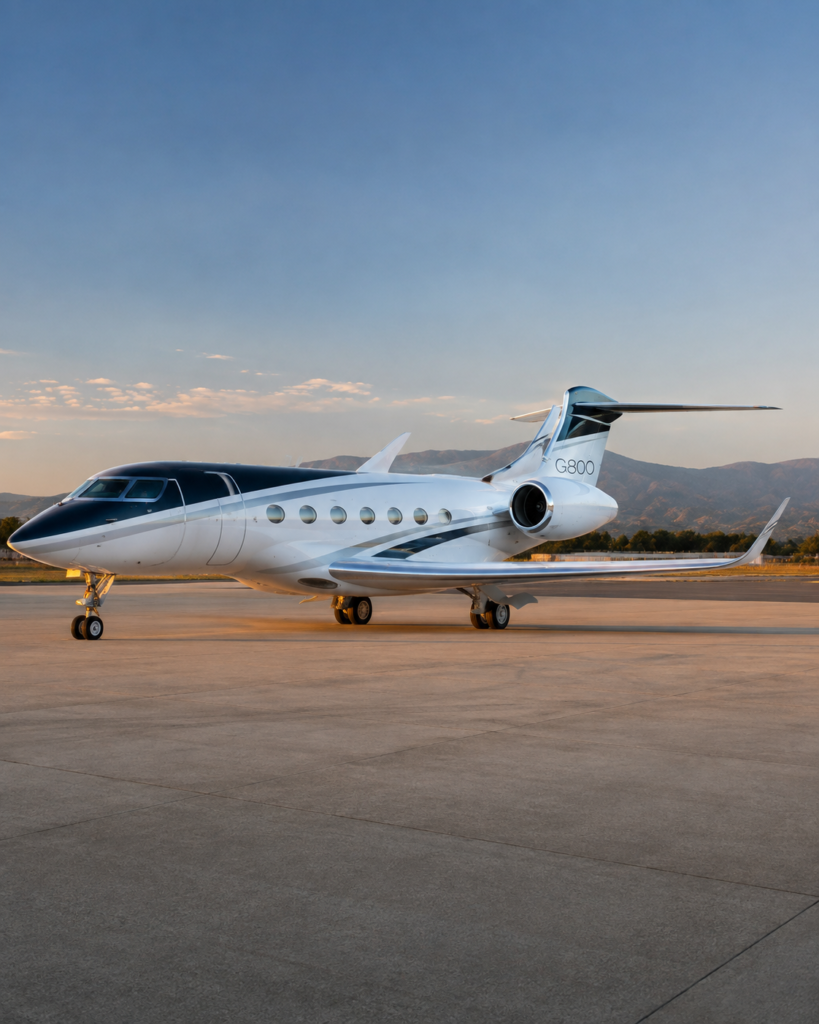
Which Gulfstream Is the best for Your Mission?
When Gulfstream introduces a new aircraft at the top of its range, it is tempting to assume that the newest model is automatically the best choice.
The Gulfstream G800 challenges that assumption.
With a maximum published range of 8,200 nautical miles, it is currently Gulfstream’s longest-range business aircraft. Yet the G700 has the larger cabin. The legendary G650ER remains remarkably capable on the pre-owned market. And for many owners, the G600 or even the G500 may cover almost every mission they actually fly.
So the real question for an aircraft buyer is not:
Which Gulfstream is the most capable?
It is:
Which Gulfstream gives me the capability I will genuinely use?
For an owner flying from Monaco, Nice, Geneva, Milan, London, Paris, Dubai, Riyadh or other major business aviation hubs, answering that question requires looking beyond headline range.
It requires looking at mission, cabin, speed, airport access, acquisition strategy and eventual resale.
And this is where the differences between the G800, G700, G650ER, G600 and G500 become much more significant than their model numbers suggest.
The Gulfstream G800 in one sentence
The Gulfstream G800 is the range specialist of Gulfstream’s current large-cabin family.
It combines an 8,200 NM maximum range, a Mach 0.935 maximum operating speed, Rolls-Royce Pearl 700 engines and up to four living areas.
The aircraft can also fly approximately 7,000 NM at Mach 0.90, which is arguably more relevant to some owners than its maximum-range figure.
Why?
Because ultra-long-range business aviation is increasingly about travelling far without necessarily travelling slowly.
That is one of the G800’s most important characteristics.
───
Gulfstream comparison: G800 vs G700 vs G650ER vs G600 vs G500
At first glance, the hierarchy appears obvious.
It is not.
Because every step down the range ladder can also change acquisition cost, operating exposure, cabin requirement and the amount of unused capability an owner is paying for.
───
G800 vs G700: range or cabin?
This is the most important comparison in the current Gulfstream family.
The G800 and G700 share the same Rolls-Royce Pearl 700 engine family, the Gulfstream Symmetry Flight Deck and a maximum operating speed of Mach 0.935.
But they were designed around different priorities.
The G800’s priority is range.
The G700’s priority is space.
The G800 offers up to four living areas and 16 panoramic oval windows.
The G700 offers up to five living areas and 20 panoramic oval windows.
More importantly, the G700’s total interior length is approximately 63 ft 8 in, compared with approximately 53 ft 7 in for the G800.
That is a significant difference.
So a buyer choosing between them is not simply deciding whether 8,200 NM is better than 7,750 NM.
The buyer is effectively deciding:
Would I rather have approximately 450 additional nautical miles of maximum range, or a substantially longer cabin?
That is a much more useful question.
───
Why would someone choose a G700 instead of a G800?
Because range is not everything.
Imagine an owner whose aircraft is primarily based in Geneva, London, Paris, Milan or Nice.
The aircraft regularly flies to:
- New York;
- Miami;
- Dubai;
- Riyadh;
- Los Angeles;
- destinations across Europe;
- occasional destinations in Asia.
A G700 already provides extraordinary range.
If the owner’s priority is entertaining guests, travelling with a larger family, separating passengers from staff, creating a dedicated office, installing a substantial dining or conference area, or having a genuinely private sleeping suite, the additional G700 cabin may be more valuable than the additional range of the G800.
The G700 can be configured with up to five living areas and can accommodate as many as 19 passengers depending on configuration.
For some owners, that makes it the more luxurious aircraft.
The fact that another model can fly farther does not make the G700 obsolete.
Quite the opposite.
The G700 and G800 are two different interpretations of a flagship Gulfstream.
───
Why choose the G800 instead?
Because at the extreme end of business aviation, additional range creates operational freedom.
The published difference between the G800 and G700 is approximately 450 nautical miles.
That may not sound transformational when comparing aircraft capable of flying more than 7,000 NM.
But maximum range should never be interpreted as a guaranteed operational radius.
Real flights are influenced by:
- headwinds;
- weather;
- ATC routing;
- passenger and baggage load;
- alternate-airport requirements;
- reserves;
- temperatures;
- airport elevation;
- aircraft configuration.
The real value of additional range is therefore often margin.
A mission that is theoretically possible in a 7,750-NM aircraft may become less comfortable operationally when winter winds or routing are unfavourable.
The G800 gives planners additional room.
For an owner regularly crossing between Europe and the western United States, Europe and Southeast Asia, the Middle East and North America, or North America and Asia, that margin can have real value.
Because a fuel stop does not simply cost fuel.
It costs time.
And for the type of passenger buying a G800, time is often the most expensive variable in the equation.
───
8,200 NM is impressive. But 7,000 NM at Mach 0.90 may be even more interesting.
The maximum range number receives the headlines.
The high-speed range may tell us more about how the G800 is intended to be used.
Gulfstream publishes a high-speed cruise range of approximately 7,000 NM at Mach 0.90 for the G800.
That gives an owner an unusual combination:
very long range + very high cruise speed.
On a flight lasting 12 or 14 hours, relatively small changes in cruise speed can translate into meaningful differences in arrival time.
Gulfstream estimates that on sectors longer than 6,500 NM, the difference between travelling at Mach 0.80 and Mach 0.90 can amount to as much as approximately 1.5 hours.
That puts the G800 in an interesting position.
Its value proposition is not simply:
Fly farther.
It is closer to:
Maintain very high speed while still retaining extraordinary geographical reach.
For globally mobile owners, that distinction matters.
───
G800 vs G650ER: replacing a legend
The comparison with the Gulfstream G650ER is perhaps even more interesting than the G700 comparison.
For more than a decade, the G650 family became one of the defining aircraft of modern business aviation.
The G650ER offered approximately 7,500 NM of maximum range at Mach 0.85 and a maximum operating speed of Mach 0.925.
Its reputation was built not only around specifications but around real-world operation, global fleet experience and an extraordinary collection of city-pair speed records.
Production of the G650 family ended in 2025.
The G800 now occupies the position of Gulfstream’s extreme-range aircraft.
But that does not make the G650ER irrelevant.
It makes it a pre-owned-market proposition.
And that completely changes the comparison.
───
A new G800 and a pre-owned G650ER are not competing on specifications alone
For a buyer, the question might be:
Do I need the newest generation of Gulfstream technology, or do I want access to 7,500 NM-class performance through a mature aircraft available on the pre-owned market?
The G800 introduces the newer Gulfstream architecture:
- Rolls-Royce Pearl 700 engines;
- Symmetry Flight Deck;
- active control sidesticks;
- extensive touchscreen avionics;
- Combined Vision System;
- new-generation cabin technology;
- improved range;
- improved high-speed performance.
The G650ER, however, brings something the G800 cannot yet replicate:
more than a decade of fleet history.
That can be valuable.
Maintenance behaviour is extensively understood.
There is an established operator network.
Aircraft appear on the pre-owned market across different ages, specifications, maintenance programmes and price levels.
For the right buyer, a carefully selected G650ER may therefore remain an extremely compelling aircraft.
───
The G650ER could become particularly interesting as a pre-owned acquisition
Aircraft markets do not move in a straight line.
When a successor arrives, some buyers immediately want the latest model.
Others begin looking at what the new aircraft does to the residual value of the previous generation.
The end of G650 production and the arrival of the G800 therefore create an interesting period for buyers.
A G650ER acquisition should not be evaluated simply by comparing its 7,500 NM range with the G800’s 8,200 NM.
A buyer should ask:
- What is the acquisition-price difference?
- What maintenance events are approaching?
- Are the engines enrolled in an appropriate programme?
- What is the cabin condition?
- Which connectivity systems are installed?
- What avionics upgrades have been completed?
- How attractive will this particular serial number remain at resale?
- How much of the G800’s additional capability would actually be used?
These questions can potentially be worth millions.
───
G800 vs G600: when the mission changes the answer completely
Move from the G800 to the Gulfstream G600, and the conversation changes.
The G600 offers approximately 6,600 NM of maximum range, high-speed cruise at Mach 0.90 and a maximum operating speed of Mach 0.925.
It can offer up to four living areas.
That is already enough aircraft for an enormous number of private owners.
Consider a typical European-based principal whose travel revolves around:
Europe – North America
Europe – Middle East
Europe – Africa
Europe – selected destinations in Asia
How often will that owner genuinely require more than 6,600 NM?
If the answer is “a few times per year”, purchasing the additional capability of a G800 deserves careful financial analysis.
Because occasionally stopping for fuel may be less expensive than owning unused range throughout the aircraft’s entire ownership period.
That does not make the G600 better.
It makes it potentially better matched to the mission.
───
The G600 may be one of the most rational Gulfstreams for an international owner
There is a tendency in aircraft acquisition to focus on edge cases.
“What if I need to fly nonstop from Europe to somewhere exceptionally remote?”
It is a legitimate question.
But it should not outweigh what the aircraft does during the other 90 or 95 percent of its flights.
For an aircraft based around Geneva, Milan, Nice, Paris or London, a 6,600-NM range already places an enormous part of the world within nonstop reach under suitable conditions.
Gulfstream itself cites missions such as London–Beijing and New York–Dubai when illustrating G600 capability.
For an owner who wants four cabin zones and serious intercontinental range without entering G700/G800 territory, the G600 occupies a particularly interesting position.
───
G800 vs G500: buying for the missions you actually fly
The Gulfstream G500 brings the maximum published range down to approximately 5,300 NM.
Its maximum operating speed remains an impressive Mach 0.925, while high-speed cruise is Mach 0.90.
It offers up to three living areas.
At this point, it becomes easy to dismiss the aircraft when comparing it with an 8,200-NM G800.
That would be a mistake.
An owner flying mainly:
- within Europe;
- Europe to the Middle East;
- Europe to the East Coast of North America;
- intra-Middle East;
- selected longer sectors;
may find that the G500 addresses the majority of real annual travel requirements.
The important question becomes how often the owner needs the final 2,900 NM separating the published ranges of the G500 and G800.
If those missions are extremely rare, chartering a different aircraft for exceptional sectors can sometimes be more rational than owning extreme-range capability permanently.
Every owner is different.
That is precisely why aircraft selection should begin with an analysis of historical and expected travel rather than a manufacturer’s product hierarchy.
───
The biggest mistake when comparing Gulfstreams
One of the most common mistakes in aircraft acquisition is assuming that the models form a simple ladder:
G500 → G600 → G650ER → G700 → G800
with each aircraft automatically being “better” than the previous one.
They do not.
They represent different combinations of:
range, cabin volume, speed, capital requirement and mission flexibility.
The G800 is not a G700 with a higher number.
The G700 is not simply an obsolete step below the G800.
The G650ER is not suddenly irrelevant because production has ended.
And a G600 is not an inadequate aircraft because it cannot fly 8,200 NM.
Aircraft should be matched horizontally to a mission, not vertically to a model number.
───
The G700 vs G800 decision may actually be the easiest to understand
A useful way to simplify it is this:
G800 = maximise geography.
G700 = maximise cabin.
That is deliberately simplified, because both aircraft have exceptional range and exceptional cabins.
But it captures the fundamental distinction.
The G800 offers:
- 8,200 NM maximum range;
- 7,000 NM high-speed range at Mach 0.90;
- up to four living areas;
- 16 panoramic oval windows;
- maximum Mach 0.935.
The G700 offers:
- 7,750 NM maximum range;
- 6,650 NM high-speed range at Mach 0.90;
- up to five living areas;
- 20 panoramic oval windows;
- maximum Mach 0.935;
- substantially more interior length.
If most missions sit safely within both aircraft’s capability, the decision may have more to do with what happens inside the aircraft than how far it can fly.
───
Airport performance matters too
Range is only one part of operational flexibility.
The G800’s certified take-off distance at sea level, ISA and maximum take-off weight is approximately 5,812 ft.
The corresponding published figure for the G700 is approximately 5,995 ft.
Those differences will not determine every purchase, but they illustrate an important principle:
An ultra-long-range aircraft should not only be evaluated by where it can reach once airborne.
Buyers should also examine:
- runway requirements;
- typical operating weights;
- hot-and-high performance;
- destination airport restrictions;
- hangar dimensions;
- airport curfews;
- parking availability;
- handling infrastructure.
This becomes particularly relevant for owners regularly using smaller business aviation airports around Southern France, Switzerland, Northern Italy and Mediterranean destinations.
Theoretical range is useful.
Real-world airport compatibility is essential.
───
New generation Gulfstream flight decks: G800, G700, G600 and G500
One of the clearest dividing lines between the G650 generation and newer Gulfstreams is found in the cockpit.
The G500 pioneered Gulfstream’s Symmetry Flight Deck, which is also used across the newer large-cabin family.
Among its defining elements are active control sidesticks and extensive touchscreen interfaces.
The G700 and G800 further integrate technologies such as Gulfstream’s Combined Vision System through dual head-up displays.
For an owner operating multiple Gulfstreams, commonality can also have operational value.
Training, crew transition, cockpit familiarity and fleet management can matter when aircraft ownership is considered across an organisation rather than as a single isolated asset.
───
Which Gulfstream should you buy?
There is no model that is right for every owner.
But the decision can be framed more clearly.
Consider the Gulfstream G800 if:
You regularly operate extremely long international sectors, want the greatest possible nonstop mission margin and value high-speed ultra-long-range performance more than having the longest cabin in the Gulfstream family.
Consider the Gulfstream G700 if:
You want extraordinary ultra-long-range capability but place greater value on cabin length, passenger separation, up to five living areas and maximum flexibility inside the aircraft.
Consider a pre-owned Gulfstream G650ER if:
You want proven 7,500-NM-class ultra-long-range performance and are prepared to evaluate individual pre-owned aircraft carefully according to age, maintenance condition, programmes, specification and market value.
Consider the Gulfstream G600 if:
You need serious intercontinental range and a large multi-zone cabin but your typical missions do not justify the additional capability and capital associated with a G700 or G800.
Consider the Gulfstream G500 if:
Your mission profile is predominantly transcontinental, transatlantic or medium-to-long-range international travel and 5,300 NM covers the majority of your real flying.
───
And what about the Gulfstream G400?
The G400 belongs in the broader Gulfstream comparison, but it addresses a different mission profile.
With a currently published preliminary maximum range of approximately 4,200 NM, it moves the discussion away from ultra-long-range ownership and toward efficient large-cabin travel.
For an owner primarily operating around Europe, North Africa and the Middle East, or on selected transatlantic missions, it may ultimately deserve consideration.
But comparing a G400 directly with a G800 is less about choosing between two versions of the same mission and more about deciding how much aircraft the owner actually needs.
───
From Monaco to New York — or Geneva to Singapore?
Geography is one of the simplest ways to begin an aircraft acquisition analysis.
An owner based around Monaco or the French Riviera may typically operate through Nice Côte d’Azur.
Another may keep an aircraft in Geneva, Zurich, Milan, London or Paris.
A Middle Eastern owner may centre operations around Dubai, Abu Dhabi or Riyadh.
The correct Gulfstream changes according to where those owners travel next.
An owner frequently connecting Europe with New York, Miami and Dubai has a very different mission from an owner regularly connecting Europe with Singapore, Hong Kong, Tokyo or the West Coast of the United States.
The aircraft should reflect that difference.
This is why generic statements such as “the G800 is the best Gulfstream” have very little practical meaning.
It is the most capable Gulfstream in certain areas.
Whether those capabilities are worth paying for is an entirely different question.
───
Buying a Gulfstream is not only an aircraft decision
A private aircraft is also an asset.
That means the acquisition analysis should extend beyond performance.
Before buying a new or pre-owned Gulfstream, an owner should evaluate:
- acquisition price;
- current market availability;
- maintenance status;
- engine programmes;
- scheduled inspections;
- aircraft age and utilisation;
- avionics configuration;
- connectivity;
- cabin specification;
- damage and repair history;
- geographical history;
- crew requirements;
- operating costs;
- expected annual utilisation;
- future market liquidity;
- probable resale strategy.
This is particularly important in the pre-owned G650ER, G600 and G500 markets.
A “cheap” aircraft approaching substantial maintenance expenditure may ultimately be more expensive than an aircraft with a higher initial asking price.
Likewise, an unusually expensive aircraft may justify its premium through maintenance status, programmes, cabin, pedigree and future resaleability.
The model name alone does not answer those questions.
───
The correct question is not “Can it fly there?”
The better question is:
How often will you fly there, with whom, under what conditions and at what cost?
That changes the acquisition process completely.
Suppose an owner completes 120 sectors per year.
If 110 can comfortably be flown by a G600 and only 10 meaningfully benefit from a G800, the analysis should quantify the economic value of those ten missions.
Alternatively, if a globally mobile owner regularly operates sectors close to the practical limits of a G600 or G650ER, the additional flexibility of the G800 may be extremely valuable.
The answer is not contained in a brochure.
It is contained in the owner’s mission history.
───
───



Considering the acquisition or sale of a Gulfstream?
Choosing between a Gulfstream G800, G700, G650ER, G600 or G500 should begin with your mission — not with a model number.
At Superba Consulting, we support private owners, companies and buyers throughout the aircraft acquisition, sale and management process.
Our approach combines operational aviation experience with technical and commercial aircraft analysis, allowing each aircraft to be evaluated not only on paper, but in relation to the missions it will actually perform.
From identifying the appropriate aircraft and analysing the market to aircraft evaluation, negotiation, acquisition and management after delivery, the objective remains the same:
to select the right aircraft for the owner, rather than simply the most impressive aircraft on the market.
If you are considering acquiring, selling or replacing a Gulfstream, contact Superba Consulting for an independent evaluation of the aircraft, its market and your mission requirements.