

Bombardier Global 8000 vs 7500, 6500, 6000 and 5500:
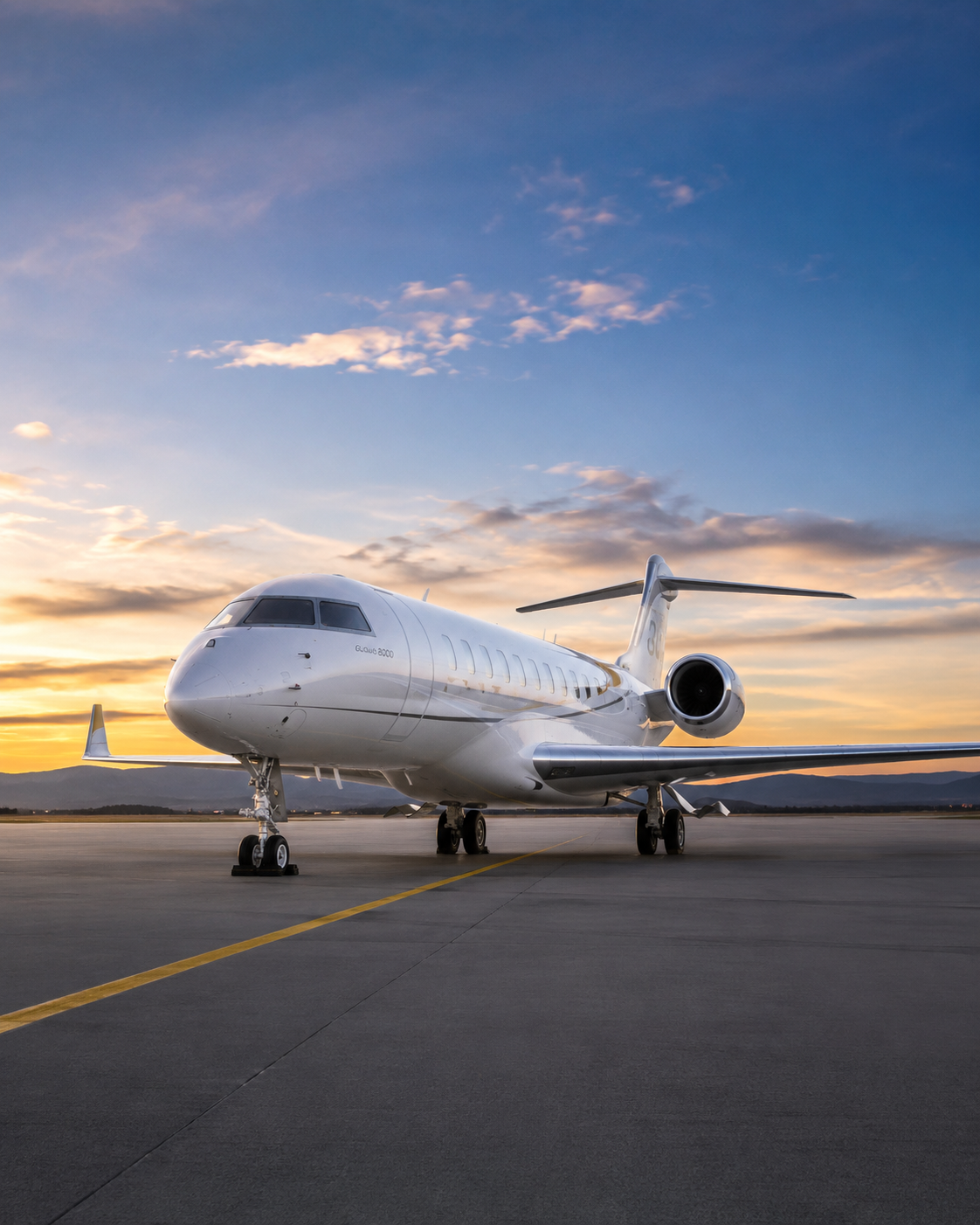
The Differences That Actually Matter
The arrival of the Bombardier Global 8000 has created an apparently simple question for private aircraft buyers:
How different is it really from the Global 7500 — and how far has Bombardier moved from the Global 6500, 6000 and 5500?
Looking only at specifications gives an incomplete answer.
The Global 8000 offers an 8,000-nautical-mile maximum range, a top speed of Mach 0.95 and four true living spaces. Those numbers are impressive, but the real distinction becomes visible only when the aircraft is considered as an operational tool.
For an owner regularly travelling between Europe, North America, Asia and the Middle East, an additional few hundred nautical miles are not simply “more range”. They can represent greater routing freedom, better margins against winds, fewer technical stops and more flexibility when airports, weather or payload make the theoretical mission less straightforward.
And that is where the Global 8000 begins to separate itself from the generations that came before it.
The short answer: what is the difference between the Bombardier Global 8000 and previous Global models?
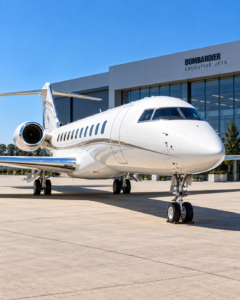
The Global 8000 is Bombardier’s current flagship and the highest-performance development of the Global family.
It offers:
- 8,000 NM maximum range
- Mach 0.95 maximum operating speed
- four true cabin living spaces
- exceptionally low cabin altitude
- ultra-long-range intercontinental capability
- the possibility of operating city pairs that leave less margin for previous-generation aircraft
The Global 7500 is its closest relative. It shares the same fundamental aircraft platform and four-zone cabin philosophy, but offers 7,700 NM of maximum range and a lower maximum operating speed.
The Global 6500 moves into a different proposition: 6,600 NM of range, Rolls-Royce Pearl 15 engines and a slightly smaller cabin architecture designed for owners who need serious intercontinental capability without necessarily requiring the scale of a 7500 or 8000.
The Global 6000, with 6,000 NM of range, represents the highly proven previous generation of the long-range Global platform.
The Global 5500, at 5,900 NM, offers many of the technological and cabin improvements introduced with the 6500 while addressing missions where the additional size and range of Bombardier’s flagship aircraft may simply not be necessary.
That sounds like a straightforward hierarchy.
In reality, choosing between them is more interesting.
Bombardier Global family comparison
Technical figures are based on Bombardier published aircraft specifications available as of 2026.
Global 8000 vs Global 7500: more evolution than revolution
This is the most important comparison.
Anyone stepping from a Global 6500 into a Global 8000 will immediately recognise that they are dealing with a substantially different aircraft proposition.
Moving from a Global 7500 to a Global 8000 is different.
The Global 8000 is an evolution of the 7500 platform rather than an entirely unrelated aircraft. The fundamental cabin dimensions and four-zone concept remain closely related.
So why does the Global 8000 exist?
Because Bombardier has pushed an already extreme aircraft further into its performance envelope.
Maximum range increases from 7,700 NM to 8,000 NM, while maximum operating speed increases from Mach 0.925 to Mach 0.95.
Three hundred nautical miles might appear insignificant when discussing aircraft already capable of flying for more than fourteen hours.
Operationally, however, range should never be considered as a simple line drawn around an airport.
Wind, temperature, passengers, baggage, reserves, routing, alternate airports and air traffic restrictions can all affect whether a mission remains practical nonstop.
For that reason, the additional capability of the Global 8000 is better understood as mission margin rather than simply mission distance.
That distinction matters.
Why 8,000 nautical miles matters differently from 7,700
A brochure tells you how far an aircraft can theoretically fly.
An aircraft acquisition analysis asks a different question:
How reliably can it fly the missions you actually intend to operate?
Consider an owner based between Monaco, Geneva, Milan or London whose schedule regularly includes Los Angeles, Singapore, Hong Kong, Dubai or other long-distance business centres.
The objective is rarely to reach exactly 8,000 nautical miles.
The objective is to reduce the number of occasions on which operational circumstances turn a nonstop flight into a fuel stop.
That is why ultra-long-range aircraft should be evaluated around real city pairs rather than headline range.
The Global 8000 effectively increases the geographical envelope within which an owner can plan missions with confidence.
For some buyers, that difference will justify moving to the flagship.
For many others, it will not.
And understanding which group you belong to can potentially matter far more financially than the difference between 7,700 and 8,000 written in a brochure.
Speed: Mach 0.95 sounds spectacular. Does it matter?
Yes — but not in the way many aircraft comparisons suggest.
The Global 8000 has a maximum operating speed of Mach 0.95, making it the fastest civil aircraft in service since Concorde.
That is an extraordinary engineering achievement.
But an aircraft owner should not interpret Mach 0.95 as the speed at which every mission will be flown from take-off to landing.
Flight planning is always a balance between speed, range, fuel, winds, air traffic requirements and operational priorities.
The advantage becomes more relevant when the owner places a high value on time flexibility.
A faster aircraft can provide additional options when:
- schedules change unexpectedly;
- a business meeting finishes later than planned;
- a same-day intercontinental connection matters;
- crew duty limitations become relevant;
- the aircraft is operated intensively across several regions.
For a lightly utilised aircraft flying predominantly European or transatlantic routes, maximum speed alone would be a poor reason to change aircraft.
For a globally mobile principal whose aircraft is essentially an extension of the office, the calculation can be different.
Cabin: the Global 8000 and 7500 belong to another category
Range receives most of the attention.
Cabin architecture may actually be the greater distinction between the 8000/7500 and the smaller Global aircraft.
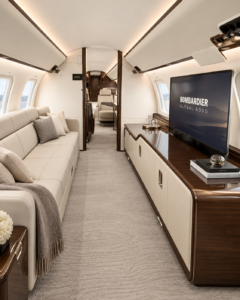
Both flagship models are built around four true living spaces.
That allows the aircraft to function less like one long passenger cabin and more like a sequence of independent environments.
Depending on configuration, an owner can separate areas for:
- work;
- dining and meetings;
- entertainment;
- rest or a private suite.
That changes the experience on a 12-, 13- or 14-hour flight.
On shorter flights, additional cabin zones can feel like luxury.
On ultra-long missions they become functional.
A passenger may conduct a meeting, have dinner, sleep for several hours and prepare for arrival without using the same seat or even the same section of the aircraft.
This is one of the reasons comparing a Global 8000 solely with a Global 6500 by range misses much of the point.
They solve different cabin requirements.
Global 8000 vs Global 6500: when “less aircraft” may actually be the better aircraft
The Bombardier Global 6500 offers 6,600 NM of maximum range and reaches Mach 0.90.
Those are still serious intercontinental capabilities.
Its Rolls-Royce Pearl 15 engines, updated wing and redesigned cabin represented a significant evolution from the Global 6000 generation. Bombardier states that the Global 5500 and 6500 gained additional range while improving fuel burn compared with the aircraft from which they evolved.
For an owner frequently travelling:
Europe – Middle East
Europe – North America
Europe – selected destinations in Asia
Middle East – Asia
the 6500 may cover a very high percentage of the required mission profile.
And this leads to a principle that is often overlooked in private aircraft acquisition:
The aircraft with the greatest capability is not automatically the aircraft that best fits the owner.
If an owner rarely exploits the fourth cabin zone or the final 1,400 NM of an 8000’s range envelope, the Global 6500 deserves serious consideration.
Aircraft acquisition should therefore begin with mission analysis, not model selection.
Global 6500 vs Global 6000: a more significant generational change than the names suggest
The difference between “6000” and “6500” appears small.
Technically and operationally, it is meaningful.
The Global 6000 uses Rolls-Royce BR710 engines and offers approximately 6,000 NM of maximum range.
The Global 6500 introduced Rolls-Royce Pearl 15 engines, aerodynamic improvements and approximately 600 additional nautical miles of maximum range, bringing total capability to 6,600 NM.
The newer aircraft also incorporates the more recent Bombardier cabin philosophy, including Nuage seating and updated cabin technology.
For buyers considering the pre-owned market, however, the answer is not automatically “buy the newer aircraft”.
A well-maintained Global 6000 with attractive maintenance status, engine coverage, avionics configuration, connectivity, cabin condition and ownership history may represent a very different financial proposition from a Global 6500.
This is where aircraft selection becomes aircraft-specific rather than model-specific.
Two aircraft carrying exactly the same model designation can represent substantially different acquisitions.
Why the Global 6000 still matters
New aircraft inevitably dominate headlines.
The pre-owned market works differently.
The Global 6000 has accumulated years of operational experience around the world and offers a combination of cabin space, approximately 6,000 NM of range and a mature support ecosystem.
For an owner whose missions fit comfortably inside its range envelope, the Global 6000 can remain highly relevant.
Its disadvantages relative to newer Globals are real: earlier-generation engines, lower maximum speed and older technology depending on aircraft configuration.
But depreciation changes the equation.
The correct comparison is not simply:
Global 6000 vs Global 8000 — which aircraft is better?
The useful question is:
What capability does the owner require, and how much capital should rationally be allocated to obtain it?
Those are very different questions.
Global 5500: the aircraft that can be overlooked in an 8,000-NM conversation
The Global 5500 often receives less attention precisely because it sits below the extreme end of the Global family.
That can make it interesting.
With 5,900 NM of maximum range and Mach 0.90 maximum speed, the aircraft already covers many missions commonly operated by European business aviation owners.
From bases such as Geneva, Nice, Milan, Paris or London, 5,900 NM represents substantial geographical reach.
If the actual travel pattern consists largely of Europe, the Middle East, North America and selected longer missions, purchasing capability designed for much more extreme sectors may not always produce an equivalent operational benefit.
A smaller mission envelope does not automatically mean a lesser aircraft.
It may mean a more accurately specified one.
What about the Bombardier Global 7000?
The Bombardier Global 7000 is not a separate predecessor sitting between the 6500 and 7500.
Global 7000 was the original name of the programme that became the Global 7500.
Bombardier renamed the aircraft in 2018 after increasing its projected range from 7,400 to 7,700 nautical miles.
This distinction is still useful because Global 7000 remains a common search term among owners and buyers researching the history of the aircraft.
One unusual advantage of the Global 8000: the Global 7500 upgrade path
The relationship between the 7500 and 8000 is particularly interesting because existing Global 7500 aircraft can be modified to incorporate Global 8000 performance changes.
Regulatory documentation for the Global 8000 upgrade identifies changes including an expanded Mach envelope, additional thrust capability, increased fuel volume, lower cabin altitude and associated avionics and systems modifications.
In other words, the 8000 is not merely a successor that makes every 7500 technologically obsolete overnight.
For an existing Global 7500 owner, the decision may therefore be:
upgrade the aircraft, retain it in its existing configuration, or move to a new-production Global 8000?
That becomes an asset-management decision as much as an aircraft-selection decision.
And it may have implications for future residual values across the Global 7500 fleet.
Global 8000 vs 7500 vs 6500 vs 6000 vs 5500: which should you buy?
There is no universally correct answer.
But the mission profiles can be simplified.
Choose the Global 8000 if:
You regularly operate very long intercontinental missions, value maximum nonstop flexibility, require four distinct cabin zones and want the highest-performance aircraft currently available within the Bombardier Global family.
Consider the Global 7500 if:
You want essentially the same extraordinary cabin scale and ultra-long-range architecture but your missions fit inside the 7,700 NM envelope — particularly when an attractive existing aircraft or upgrade opportunity is available.
Consider the Global 6500 if:
You require genuine intercontinental range but do not regularly need the fourth cabin zone or the extreme range of the 7500/8000 platform.
Consider the Global 6000 if:
You prioritise a proven long-range platform and the economics of the pre-owned market, and your typical missions remain comfortably within approximately 6,000 NM.
Consider the Global 5500 if:
Your missions require substantial international capability but the scale of the larger Global aircraft would add capability that you are unlikely to use.
The most expensive aircraft is the wrong aircraft bought for the wrong mission
Private aircraft comparisons often assume that each newer model automatically replaces the one below it.
Ownership does not work that way.
A private jet is a combination of:
mission capability + acquisition cost + depreciation + maintenance exposure + crew + utilisation + airport access + cabin requirement + eventual resale strategy.
The best aircraft is therefore not necessarily the one capable of flying the farthest.
It is the aircraft whose capabilities most closely match how the owner actually travels.
For one owner, that may unquestionably be a Global 8000.
For another, a carefully selected Global 6000 may fulfil almost every annual mission while creating a very different ownership economics.
Knowing the difference before entering negotiations can be worth considerably more than knowing which aircraft has the longest range.
Buying a Bombardier Global: why aircraft-specific analysis matters
Once the correct model has been identified, the work is only beginning.
Especially in the pre-owned market, an acquisition should consider far more than year of manufacture and total flight hours.
A professional evaluation should include areas such as:
- aircraft and maintenance history;
- upcoming inspections;
- engine and APU programmes;
- damage history;
- avionics and regulatory compliance;
- connectivity systems;
- cabin configuration;
- modifications and upgrades;
- geographical operating history;
- market positioning;
- asking price versus actual market value;
- likely future resale positioning.
This is where two apparently similar Global aircraft can become two completely different investment decisions.
At Superba Consulting, aircraft acquisition, sale and management decisions are approached from both an operational and commercial perspective, helping owners evaluate not only which aircraft is desirable, but which aircraft makes sense for the missions it will actually fly.
Looking for a Bombardier Global aircraft?
Choosing between a Global 8000, Global 7500, Global 6500, Global 6000 or Global 5500 should begin with the missions you intend to fly — not with the number printed on the aircraft.
Superba Consulting provides independent support for private aircraft acquisition, sale and management, combining aircraft selection, market analysis, technical evaluation and negotiation into one advisory process.
If you are considering acquiring or selling a Bombardier Global, contact Superba Consulting to evaluate the aircraft, the market and the mission before making the decision.